I have just finished reading, as I do on a daily basis, an article from the Yoga Journal. (A link to the website is on the sidebar for your information). At first I thought I would summarize it here, as it relates in many ways to what we've been discussing recently re: mindfulness, getting out from the shadow of the past, living in the present moment etc. But it is so well written, I have simply given you below a link to the article. It is quite long but I hope you will have the patience to see it through to the end. There are some very important truths in it, very well written, and quite thought provoking. Just click on the link below and it should take you directly to the article.Your comments are most appreciated.Enjoy with my lovehttp://www.yogajournal.com/wisdom/445_5.cfm
"The Soul Always Knows What to do to Heal Itself. The Challenge is to Silence the Mind"
Now that we've all had a go at washing dishes with mindfulness and seen that it is in no way as simple as it sounds, we can move on to further understanding and practical applications of mindfulness in our daily lives. Firstly however, after a comment I received regarding my previous post which had led to some misunderstanding, I would like to clarify for all of you, so I am posting here the comment, sent by Avik, as well as my reply, in the hope that it will lead to a better understanding of the dish washing exercise for all of you.
"I have been reading your blogs (what a terrible word!) with great pleasure, and now relate to the one about Living in the Present.........Like anything else of value, when taken to extremes it loses some of its lustre. When trying to fit Washing Dishes into this scheme of things, I think that kind of blew the fuse. How can you enjoy washing dishes, that mindless, energy sapping fruitless task? This is a typical time when one can skip into another world of thoughts, memories, future expectations. Yes, I believe that there is a place for these in life, apart from most of the time living in the present in an enjoyable way. This is what distinguishes us from the animals. As long as one does not transfer the main spring of life into the realm of wishful thinking, I think there is much pleasure in little episodes of reflection and remembering and designing plans for future projects. Let us not lose these jewels altogether, even while recognizing that they are not a substitute being Here and NOw." ...and my reply: I think you miss the point. No one says you have to enjoy washing the dishes. If you begin to think about enjoying it, again, you are not thinking about the act of washing the dishes. This is just an example any way, as to how people can learn to be mindful of each moment….be completely in the moment. The idea is just, every once in awhile, to focus completely on the task at hand…not in order to enjoy it, but in order to experience it fully. I actually tried this over the weekend with something else which I hate doing and try to get it over as quickly as possible to move on to something else. Folding clothes. And it turned out that when I completely focused on it, I found great tranquility in the exercise, much as I do in any other form of meditation. The whole idea of completely focusing is to bring us to a point where we can move on to using this concentration the moment in our meditation practices. The act itself is all we need to focus on…not to involve any feelings of enjoying, boredom….no form of judgement or thought, just paying attention to what is happening and focusing on it….I agree with what you say about taking things to the extreme and certainly finding myself thinking of anything but the traffic I am driving in to work each morning, is a wonderful way to get through the drive each morning. But every once in awhile I become completely mindful of the drive and then find that it also can become almost meditative in effect…I look at the sky, see the buildings, read the bumper stickers, everything which is part of the drive itself. This is all the post was trying to get at…Dreaming is wonderful and a very pleasant way of getting away from the present which is not always as pleasant as we would like it to be…but learning to focus is the point here… I hope this explains the idea a little better…if not, I’m open for more discussion Nice to hear from you…hope life is treating well “every moment of every day” OK, now back to some practical ideas about bringing mindfulness into your everyday life...the idea is to try, as often as possible during the day, to really be completely in the moment, no matter what is happening at that particular moment. So here are a couple of further ideas to try which may help bring you more into the now.
Once every hour, stop whatever you are doing for 1-3 minutes and bring your focus, your awareness to your body and any sensations you have-feel your body completely from head to toe, inside and out. Allow the sensations to flow over you for a minute or so, with no comment or judgement. Just feeling. Then bring your awareness to the room around you, to your surroundings, and take stock as well. What do you see, notice, sense that you didn't before you became aware. And finally, bring your focus to your breathing. Just notice the inhale and exhale. Is your breathing full and deep, or shallow and weak. Don't judge, just notice. Do the above, once every hour (set a timer or put a note on your computer at work) for a few days. Just flow with the exercise. This will help prepare you for the next step in using mindfulness.
Raise your awareness anew every time you eat. What you will find is that every apple, slice of toast, or meal in your favorite restaurant has its own unique, subtle qualities that often slip by, unnoticed, when you eat habitually or in a distracted state of mind. If you can bring yourself back to the present moment for just an instant and pause to see how your food aligns with you deep in your core, you'll find you have an another unfailing tool for knowing what the moment is truly about.
Another idea you may like to try is a Walking Meditation. Try out this link Walking Meditation and see if it is something you may enjoy. I find it sometimes quite difficult, but if I stick with it, get enormous pleasure and tranquility from the exercise. (You might enjoy this website as well and you can even sign up free for a daily insight as well as a monthly newsletter. There is lots of interesting stuff here, not just about yoga. The link is on the sidebar of my blog as well...check it out!)
Now, I'd like to try working with you using a very simple technique for beginning mindfulness meditation per se. Not just an exercise for become more aware in the day to day, but the actual beginnings of a meditation practice. Once you've tried the following, and would like to delve even more into this type of meditation, find more insights and practical use of this form of meditation, a good starting point is a book mentioned in my last post by Jon Kabat-Zinn "Mindfulness Meditation for Everyday Life"...check it out of any of 1000's of websites on the subject which you can Google and start going through them.
And now...let's begin...this is the type of meditation practice which is done even with large audiences during teachings by Tenzin Palmo, and I quote part of it from her book "Reflections on a Mountain Lake"...
"Now, I would like us all to sit quietly for about fifteen minutes. If your mind has strayed away, bring it back into the room. Then bring it into the body. If there are sensations in the body, just note them. Don't comment on whether you like them or dislike them. Just know that they are present. Know the body. When you have become settled in knowing the body, bring your attention to the in-going and out-going of the breath. Just be one with the breath as it flows in and flows out. Don't try to make the breath longer or shorter. This is not really concentrating, in the sense that we are not looking at the breath from a distance. We are just becoming one with the breath, knowing it as it comes in and as it goes out. When thoughts arise in the mind, don't be concerned. It is the nature of the mind to have thoughts. Don't give them any energy. Don't get caught up in them. Ignore them. If people try to attract our attention and we ignore them, eventually they will give up and go away. Thoughts may come and go, but we are not interested in them. We just bring the attention back again and again to breathing in and breathing out. We will do this for about fifteen minutes. When sounds occur, they are just sounds, just vibrations moving across space. No problem. Sounds are naturally there, and it is natural for the ear to hear them. Don't give them any energy. Just go back to the breath."
If you find this difficult to do for 15 minutes, a suggestion for beginning this kind of practice from Jon Kabat-Zinn is to begin by counting the breath in series of 10. Count each breath as 1 count (you can either count inhale 1, exhale 2...or inhale + exhale as 1 count, whatever you like). When you reach ten, go back to one. If you get confused in the middle, go back to one each time. This gives a little bit more focus on the breath for beginners and makes it somewhat simpler to move along.
In addition, do not try to EMPTY the mind. Try to learn to be stronger than the mind...to rise above it...only then can we begin learning to hear what our heart/soul/intutition is telling us.
Don’t meditate until you are bored. Then you will not feel like doing it again…stop while it is still pleasant so you will look forward to doing it next time and as soon as possible, instead of viewing it as a chore. Like reading a good book and having to put it down at the best part…you can’t wait to get back to it again.
I have concentrated all the recent posts on mindfulness together as well so you can easily refer back to them for more clarification.
I know this has been a long post but look forward to hearing your comments and suggestions. I am thinking of now moving on to a discussion of the 5 Reiki Prinicples as noted above in the description of the blog...that is my next direction for this blog.
Below you will find a journal entry written November 7th, 2004 following my meeting withTenzin Palmo in Tashi Jong. Anyone wanting more information about her can comment here and I will get back to you. Also, in the previous post about Mindfulness, there are a couple of recommendations for books as well as a link to her website. Enjoy!
Tenzin Palmo
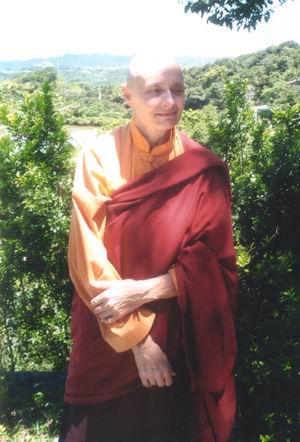
It's still Sunday and back after going one more time to Naddi. but it's been a strange day and strange kind of feeling for me...abdellah actually complained to me that I am too quiet(!) today!!! I feel this strange sense of inner calm about me since yesterday's meeting with this amazing western nun who spent 12 years in a cave in retreat and has since become THE representative of womens rights in Tibetan Buddhism, and is now finishing the construction of a nunnery in Tashi Jong (which has already been running for 3 years, I believe) which is the first of its kind in Buddhism. It offers full studies to women including debating and all aspects of Buddhist study generally reserved until now for men only. I won't go into any more details but she is highly respected by HH the Dalai Lama and has received his blessings for all her pursuits in this direction (although she says it is not of her doing and if it were up to here she would still be in retreat)....
Anyway, I will write a few words about what happened yesterday but nothing can really capture the way I feel right now....it would be interesting to see if I can keep this feeling of calm once I get home....
Saturday, 6th November-sitting outside the nunnery after having a light lunch following our meeting with Tanzin Palmo. We came up to Tashi Jong (about a 2 hour drive from McLeodganj), by jeep which carried Abdellah, Nicolai, Shachar, myself, and 4 russian ladies who spoke no english. I came here with a question prepared (at the suggestion of Nicolai)...but didn't need to ask. As soon as this amazing woman began answering questions from the others...I received an answer to what has been troubling me for the past 2 weeks or maybe longer. Truth is, I couldn't really put the problem into words anyway, and yet I received an answer which went directly to the core of the matter. I received this answer without ever having to speak the question in words. It was enough that I had understood it in thought. Didn't quite know why I was coming today except it seemed interesting, after I had read the book about her when I first arrived here. But it is no coincidence that I lay awake most of the night pondering the question and towards morning asking for some clarification or direction.
Funny thing was, as soon as she said whatever it was she said, (to everyone sitting there it seemed) I was overwhelmed with tears of relief and joy (and this feeling has been with me ever since...it is now sunday evening) She looked directly at me and gave me a kind nod as if saying "yes, I know!".... Everyone else was firing question after question at her, which she answered with an emormous amount of patience and understanding, but it was as if she knew that the whole reason for the meeting that day was to "hear" my question and give me the reply I so desperately needed.
At the end I went up to thank her and she immediately took both my hands in hers, (she did this to no one else) even before I began to say anything...and then I thanked her for what she gave me. The strength and compassion which flowed simultaneously from her hands to mine was astonishingly powerful. She beamed at me...gave me a one arm around the shoulder hug and I was on my way. It was quite humbling to sit in her presence and feel her total awareness and assurance that all is precisely as it should be, without any sign of ego whatsoever. Truly an amazing morning!
It’s been awhile since I’ve sat down to write…and the truth is, there are so many things I need to put down here in this blog that it has been difficult to know where to begin. So I have simply let time go by, hoping that the inspiration would come. I’ve been going through some difficult, but interesting and rewarding personal experiences the past few weeks which culminated in my being ill this past week, apparently as a final cleansing following certain processes which have been set in motion. While spending time feeling miserable, as we tend to do when we are not feeling well, I realized what should be the next matter of concern on the blog and will begin writing about it today. It may take more than one sitting to get it all done, but I feel the time is right to begin exploring together with you the matter of Mindfulness.Before discussing Mindfulness itself however, just some food for thought which will lead us into a full discussion of the topic… Previously I wrote about the power of forgiveness in helping us get out from under the Shadow of the Past. (See earlier post). Well, let’s say we have figured out how to release the past and its control over our present. That’s great! But now the big question arises…We’ve managed to escape the past, but where are we NOW living…Being? Are we now able to focus on the present, on the day, on each special, precious moment which comes our way and is over instantaneously? Can be catch the wonder and beauty of each second? Can we experience our life as it unfolds in the moment in all its amazing wonder? Or, are we still living in a place which is not NOW! And if we are no longer burdened by the past, then where are we? Truth be told, most of us are probably abandoning the now for the dream of what will be in the future. Always longing for the time when…always planning for the time we will be able to…always looking for the opportunity which will allow us to…We dwell on things that happened in the past or anticipate future events. But we almost never experience the moment itself. It is for this reason that we often find our lives boring and meaningless. This sense of meaningless does not come from our lives, but from the quality of awareness with which we live our lives. And where does that leave us today? Craving, discontented, unfulfilled, lonely, jealous and completely unaware of, and unable to experience the joy of each moment. Waiting to finish school, waiting to get out of the army, finally going on our travels but then thinking all the time about what we have to do when the trip is over, waiting to find that special someone, waiting for the baby to sit up, to walk, to say his first word, waiting for the kids to leave home, waiting to retire….and before you know it, life is over and we are still waiting for…what? And what happened to all those precious moments in between? How many of them do we remember? How often did we savor the delicious moment? How often did we look at the sky, at the grass, feel the breeze, notice the insects, examine a flower, see the animal tracks on the path, feel the hand of our lover or our child, REALLY listen to someone talking or to the sounds of Nature, hear the hum of the electric appliance running in our house (!)…notice the silence when there is an electricity cut. How often do we actually HEAR, pay attention to, enjoy the music we are listening to? How often to we see the smile, or sadness on our childrens’ faces, pay full attention to their stories when they come home from school…How often do we really fully experience the moment? Mindfulness is a concept in Buddhism, but is something which all of us can benefit from understanding. In Buddhist terms “Mind” is defined as awareness of objects or events, rather than “mental factors”, which contain the content of thoughts etc. And from this definition of “mind” comes the simple yet amazingly powerful concept of “mindfulness”. Mindfulness is being completely and totally aware of everything you are doing as you are doing it. From simple everyday things such as brushing your teeth in the morning, to driving to work, to sitting at the computer and writing this post. (I make it a point to notice everything that I feel, see, touch, sense at each moment. The breeze from the open window to my right, the hum of the computer, the feel of the hard plastic on my finger tips as I touch type, the growl of my stomach as I put off eating just to get a drop more of this written, the tenseness in my shoulders (which I instantly relax to avoid pain later in the evening), the birds singing outside the window as dusk begins, etc) It means living in the now, savoring every moment, as the moment is ALL we truly have. Just a couple of examples, one from my own personal experience…I remember my walks in the mountains which I usually did alone, and did not truly appreciate the pleasure of these walks until I started walking with other people. It seemed that everyone who went walking, was walking in order to get somewhere! The walking was goal orientated and they didn’t begin to experience the day until they “got” where they were “going”. I found this all very upsetting, as they walked at a brisk pace, totally unaware of their surroundings, talking about inconsequential things, never once experiencing the walk itself. It was only after several walks like this that I began to understand the beauty of my isolated walks…I would sometimes walk fast, but mostly just move with the flow of the surroundings. I would look around, hear my footsteps and the noises of the forest, notice the color of the undergrowth, hear the far away ripple of a brook, see the sun shining through the trees…as a matter of fact, I will post right after this a Journal entry I wrote describing one of these walks…which in itself becomes a kind of Mindfulness Meditation. An exercise in BEING in the NOW! You can skip over the following Journal Entry and go on to further discussion of Mindfulness and the example of washing dishes and come back to reading this later, or read it now to get a better feeling for what I am trying to describe and then continue on with the rest of the post. Just walked up TIPA road to Dharamkot after not taking that road in about 2 weeks. And it's as if I am walking someplace for the first time. Seems familiar but no place I've actually been this trip No more whizzing rickshaws to jump aside from or taxi's rushing up blowing their horns. And only 2 other people were seen the whole way up. As a matter of fact, the only human sound accompanying me the whole way up was the occasional scrape of my hiking boots on the road or the soft rustling of my jeans as my legs brushed against each other. And so the forest came alive! At one place there was a tree standing alone with 18(!) ravens on it just enjoying their perches in the sun and "chatting" quietly with each other. None of their usual shouting and squawking to disturb the peace of the day. It's as if the change has relaxed them as well. Further up a little hollow in the wood filled with layers of flitting butterflies. Also seeming to have been invited as well to enjoy the peace of the forest. And the foliage has all become richer and greener and more luxuriant. The fronds on the ferns are enormous with brown stems running through their centers. Some as large as huge banana leaves. And the mosses have spread to cover enormous spaces that used to be just dark damp earth. One kind had little "leaves" in the shape of stars with miniscule white pointed "flowers" almost like sitting atop the "leaves". The cicadas no longer competing with the vehicles or human voices are heard in full force. And many different kinds of bird calls can be heard from the trees. The sun is gloriously warm and blessedly obscured from time to time by the shade of the forest. Making the walk the perfect combination of cold crispness and warmth. As I approached Dharamkot, even the lilting voices of the school children seemed almost in an intrusion. A few sparse lower branches seem connected by enormous spider webs. One lone butterfly disappearing inside a clump of low lying rhododendron. A few lonely rays of sunshine manage to beam their way through the thickness of the 20-30 meter high pines to rest on the forest floor which is a combination of pine needles, low greenery, rocks and moss covered earth. Surrounded completely on all sides by total silence, except for the ever present cicadas and distant call of ravens and the occasional magpie. I feel embraced not only by the splendor of the trees all around me, but my Mother Nature herself! The trees soar upwards like needles topped with triangles of green pointed at the sun as if striving to reach the heights of heaven itself. And I sit insignificantly here but knowing that I am just as much at home here as the trees!
I am adding a video here taken this year (2007) while once again in my beloved mountains with my new digital camera...it will give you a further feeling for what I am referring to in the above...
The Above is one of the reasons I so miss being in India, as I have been 3 times in the past 5 years just at this time of the year. It does something to my soul...seems to awaking things which, try as I may, usually find hard to arouse when taking a walk anywhere here at home. Although today (this written about year later after taking a walk in the middle of Raanana) I DID have a very pleasant walk, with much mindfulness of my surroundings which actually brought tears to my eyes, allowing me to feel for a short few minutes the intensity of being in the moment that I feel so much more in the mountains in India. Now back to the very famous example of simple every day Mindfulness presented by the Vietnamese Zen Master, Thich Nhat Hanh who writes about the benefits of washing dishes to wash dishes. This is a very important point because normally we wash dishes in order to have clean dishes. Whenever we do anything, we do it to get a result. We write a letter in order to produce a letter which we can then send; we are washing dishes not to wash dishes, but so we can have clean dishes and go on to the next task. As we wash the dishes we are thinking about what we will do next, how e will have a cup of coffee, what somebody said to us this morning, what TV program we watched last night, what our kid is doing, what our husband said to us before he went to work. The last thing we have on our mind is the dishes. Then when we come to drink the coffee, we are thinking that after that we have to go shopping and what we are going to buy…or we might even go OUT for coffee with a friend but then we are talking to each other (perhaps even listening to the other person talking), but not really being there with the cup of coffee and its wonderful aroma and taste. Our entire lives pass in this way. Even when we are doing something nice, like eating a delicious meal, we are thinking about dessert. We never even truly enjoy the good things. Tenzin Palmo (the first Western woman to be ordained as a Buddhist nun in the Tibetan tradition*) speaks about this in her teachings and books as well…” I like Tirimisu very much with coffee and lots of cream-totally degenerate, but I love it. So when I eat tiramisu, it is a very pleasurable thing. At the first mouthful, I’m completely with the Tirimisu. But by the second mouthful, I am comparing it with a Tirimisu I had somewhere else which was my idea of the perfect Tirimisu, and I’ve lost this one. For the rest of the mouthfuls, I’m not really eating it anymore. It’s eating itself. I’m already somewhere else, with former glorious Tirimusus which this one should have been but isn’t. We do this every day, not only with what we think of as unpleasant things like washing the dishes, but also with pleasant things. We’re not there. We don’t experience it.” Back to Thich Nhat Hanh who asks “Why not wash dishes just to wash dishes?” We get clean dishes anyway! But it means that while we are washing the dishes, we are completely with it. There is no action in the world more important at that moment than washing the dishes because that is what we are doing. Everything else is just our thoughts. But the thing happening in the moment is the actual reality and, therefore, the most important thing. If we miss it now, we miss it forever, because we can never get that “now” time back once it has passed. So let’s try to wash the dishes and just know we are washing the dishes. It’s not a big deal. We are conscious that we are standing at the sink. Now the hand is picking up a dish. We can feel the water. We can feel the soap suds. We are conscious of what we are washing. We are completely attentive to what is happening in that moment. In this way we become centered in the moment, and that moment is all we ever really have. Our whole life is made up of moment after moment after moment. If we miss these moments through thinking about something else, they are gone forever. If you try this, you will discover that it is extraordinarily difficult. It sounds very easy, but after the first minute the mind is already either thinking, “oh, this is easy, very easy to be mindful..I can be mindful anytime….” And where are you? You’re not with the dishes, you are thinking ABOUT the dishes. Or you may be thinking “Hmmm…where did I get this dish? Ah yes…it was part of a set…where is the rest of the set…?” etc. It is very difficult to remember to be present. It’s easy to be present once we remember. But if we can do that, if we can bring this quality into our daily lives as often as possible, even for a couple of minutes each time, we will open up whole new vistas of awareness. Each moment will bring new understanding and pleasure to us, and we will truly begin to understand the wonders of each moment, of BEING in the present, which is all we truly have. In a future post I will write about Mindfulness Meditation**, which takes the above exercise one step further, but for now, even washing the dishes, or walking to the supermarket, or working on the computer, can be a form of meditation if it is done with mindfulness and if we remain completely in the moment. Remember: We have nothing if we don’t cherish and enjoy each moment. Live as if we may die tomorrow-make the most of each day. Enjoy the beauty of every minute. Live with youthful enthusiasm for each thing that comes our way. Experience things with all our senses as they happen. Be Mindful. BE…LIVE… * Recommended reading either about or by this amazing English born woman- who lived for 12 years in a cave in the Himalayas and has become a living legend: “Cave in the Snow” by Vicki Mackenzie; “Reflections on a Mountain Lake” by Tenzin Palmo. You can also check our the website of the nunnery she founded and find more interesting information: http://tenzinpalmo.com/I met her on my last trip to India at the nunnery and will post a journal entry about that visit at a later date. If you are interested in hearing more about her, you can comment here and I will get back to you. **Good first book on the topic: “Mindfulness Meditation for Everyday” by Jon Kabat-Zinn
Living in the Shadow of the Past and the Power of Forgiveness
Like your shadow on the sidewalk when the sun shines behind you,
holding onto painful past memories
darkens each forward step
which could instead be filled with light.
The above statement may seem obvious, and simple, but it is most profound and warrants further thought and attention.
Holding onto the past is probably the most universal of all human behavior patterns. It is the rare individual who lives his life entirely in the present, unburdened by influences from the past. At the same time, it is one of the main causes of worry, tension, pain, sadness, depression, anger, grief, hate, jealousy, discontent,even physical illnesses - just about everything and anything that each of us would be much better off without.
So, how can we rid ourselves of this terrible burden? There is only one way.
Forgiveness!
Forgiveness does not necessarily mean condoning things that happened to us or that were done to us by strangers, and even more difficult to deal with, by those close to us. It means reaching a point in life where we simply decide "Enough!". I will no longer allow the past to rule my life and take possession of my thoughts, feelings, reactions and dictate the way I live each day. The burden of the past is heavy enough to weigh us down until we are bent over and unable to move, stuck in a place we do not wish to be but which we do not have the energy to move out of. Only by dumping this terrible burden can we again feel light, joyful, fresh, young, energetic, enthusiastic, creative, loving, caring, compassionate, patient and tolerant, content, vibrant and full of peace and tranquility.
I am attaching some wonderful short statements, dealing with the power of forgiveness...and how our past effects each step we take in the present. They are taken from a very long list of ideas for further thought called "Your Biography Becomes your Biology" which I will post in full in a later post. For now I am just "picking and choosing" for the particular idea of forgiveness.
There are also many wonderful techniques for releasing the past, and I will explain at the end of this blog the one which I find most effective. This is from both personal experience and the experiences of many of my clients who have moved on to wonderful new places in their lives after combining the technique with other subtle forms of energy work such as Reiki and Bach Flower Remedies-but it is a technique which can work entirely on its own if taken seriously and done properly and with intent.
Look for it at the end of this post!
"Healing requires taking action--it is not a passive event.'
'What drains your spirit drains your body. What fuels your spirit fuels your body.'
'We have converted our wounds into a type of relationship currency that we use in order to control situations and people.'
'Healing means getting over the pain, not marketing it.'
'Therapy is a boat to cross the river, we just have to remember to get off on the other side.'
'Master your responses to external events--don't attempt to control them.'
'Forgiveness is like a rough diet with no payback -- you won't like it until it's over.'
Just let go. Let go of how you thought your life should be, and embrace the life that is trying to work its way into your consciousness.’
'Forgiveness doesn't look attractive until we get to the other side.’
Present time energy is its own transformer. The more energy you have in present time, the more voltage you can move through you.
‘Call back the energy you are wasting on events of the past.’
We are never being punished, only being taught. Everything is a teaching.
‘It goes without saying that not every healing crisis will have a 'fairy-tale ending,' but every effort you make, regardless of how insignificant it may seem to you, will always bring you closer to a state of spiritual and physical health.’
What is wrong with us that we have to have yesterday's grief with us today?
Forgiveness is a path to my inner laboratory.
Get bored with your past, it's over! '
Release the need to know why things happen the way they do.' '
Never look to another person to make you happy--happiness is an internal, personal attitude and responsibility.'
'Life is essentially a learning experience. Every situation, challenge and relationship contains some message worth learning or teaching to others.'
'Practice forgiveness of others.'
'Positive energy works more effectively than negative energy in each and every situation.' '
Our emotions reside physically in our bodies and interact with our cells and tissues.'
'Nothing empowers our ability to heal as much as our love and forgiveness.'
'The soul always knows what to do to heal itself. The challenge is to silence the mind.'
'Spiritual teachings encourage us to grow past and through painful experiences, each of which is a spiritual lesson.'
'Illness can develop as a consequence of behavioral patterns and attitudes that we do not realize are biologically toxic until they have already become so.' '
I am forgiving not for you, but for me. I am forgiving because I want my power back.'
'Get over it.'
'Feeling victimized only adds to your illness, and should it become a full state of mind, would qualify as an illness in itself.'
'We are addicted to the power of the wound.'
'Release victim consciousness and embrace forgiveness.'
We can achieve a genuine sense of peace about life only by releasing our need to know why things happen in terms of human reasoning and by embracing Divine reasoning.'
‘We cannot seek to heal an illness without first looking into what behavioral patterns and attitudes need to be altered in our life.’
For every time zone that we are in, other than here, we drain our life energy.
Law of the gods: get bitter or better.
A forgiving heart is an honest heart.
Blame is a form of energetic cancer.
If anyone tries to complicate your life - turn and walk away from them
If it's not about you, it's not about you
You can't understand what you can't understand
Don't make simplicity hard
Your task is to learn the lesson that the teacher has for you rather than to resent the teacher
Seen symbolically, our life crises tell us that we need to break free of beliefs that no longer serve our personal development
Our lives change externally as we change internally
View every experience as a blessing and a remedy that serves your well-being.
Illness can be a teacher, companion, or challenge-but not a punishment.
Healing requires that you admit the truth about yourself.
Embrace the changes in your life.
Bless your difficulties and ask to see their hidden guidance.
Be mindful of how often you judge others.
Become mindful of your reasons to stay angry
To be unable to forgive is to live in hell, burdened, miserable, angry
Get in present time and forgive the people who have hurt you
We are not meant to stay wounded
To blame the other players in our drama for helping to teach us what we need to learn is the height of foolishness
Understand that all experiences either make you bitter or better
Practice the art of transformation
Become mindful that remaining in a conflict is a choice
Learn that the way to set change in motion is to bless and appreciate even the most difficult parts of our life
Recognize whether you love yourself enough to heal
Realize you choose to stay angry when you can choose to heal
Sometimes the strings to our past are burned because we need a new beginning
Forgiveness Exercise:
Using a full size notebook or pad (A4, letter size), take a page and fold it in half lengthwise.
Number each line from 1 to 70.
Choose a person you wish to begin forgiving. This can be as simple as a teacher in the first grade who made you stand in the corner or as deep as an abusive parent. It can be yourself (but this is better left until later on in the forgiveness work) or even God! You may want to begin with something small and move on to the heavier duty things once you get the hang of the exercise, but there is no reason why you cannot “jump right into deep water” if you so choose.
On the left hand side of the page (remember, there is a fold line down the middle of the page), start on line one, and on each line up to 70 write: " I (your name) completely and totally forgive (name of other person)."
You will write this 70 times.
While writing this short but powerful sentence, thoughts will begin to come up into your head “Why the hell am I doing this?” “This is silly” “There is NO way I will forgive this person”> “Look at what he did to me when he….” Etc., etc. Every single thought, without censorship and without comment or contemplation, you simply write down on the RIGHT side of the fold. As they come, as they flow, just write and then immediately go back to writing the other sentence 70 times. DO NOT STOP TO READ OR THINK ABOUT WHAT YOU ARE WRITING ON THE OTHER SIDE OF THE FOLD LINE.
Once you have written this 70 times, take the piece of paper and BURN IT.
Do this for a full 7 days FOR EACH PERSON. And burn at the end of each day.
At the beginning of a new week, choose someone new to work on.
As the days go by, the thoughts that immerge from the depths of our subconscious will become less and less. There will probably be no more left by the end of the week regarding the person involved. If there ARE still many thoughts, do the same person for a second full week! But this RARELYhappens.
Once the person is taken care of and the papers are burnt, you will feel an enormous lightness overtake you. It is quite remarkable. It really does work!
If something is unclear about the above, please feel free to comment below and I will explain further. I wish you all wonderful new days filled with the relief of "dropping" the weight of the past from your shoulders, and standing tall of joyfully embrace each new day. With much love, light, health, tranquility and laughter. Jane
I am a former American, living in Israel for the past 39 years. Mother of 6, grandmother of 13 (so far), healer, Reiki Master, Israeli folkdance enthusiast, enjoying the wonder, surprise and blessing of every step of the wonderful journey called "Life".Looking forward to the next step which includes living in India.
Jane's Categories-
NEW! Simply click on a category at the end of a post and you will be taken to all posts dealing with that category.You can still use the categories below, but this new feature is easier!